Six main symbols encoded in the "Sistine Madonna"
«Genius of pure beauty» – so said Vasily Zhukovsky about the «Sistine Madonna». Later, Pushkin borrowed this image and dedicated it to an earthly woman – Anna Kern. Raphael also painted the Madonna from a real person, probably his mistress.
1. Madonna. Some researchers believe that Raphael painted the image of the Holy Virgin from his mistress Margherita Luti. According to the domestic art historian Serhii Stam, “in the eyes of the Sistine Madonna, there are frozen immediacy and openness and trust, hot love and tenderness, and at the same time wariness and anxiety, indignation and horror before human sins; indecision and at the same time readiness to perform a feat (to give up his son to death. – Ed. note).”
2. Infant Christ. According to Stam, “his forehead is not childishly high, and his eyes are not at all childishly serious. However, in their gaze, we see neither science, nor forgiveness, nor the comfort that reconciles... His eyes look at the world that has opened before him, attentively and intensely, with wonder and fear”. And at the same time, in Christ's gaze, one reads the determination to adhere to the will of God the Father, the determination to sacrifice himself for the salvation of humanity.
3. SIXTUS I. Very little is known about this Roman pontiff. He remained on the holy throne for a short time – from 257 to 258 – and was executed by Emperor Valerian by decapitation. Saint Sixtus was the patron of the Italian papal family Rovere (translated from Italian as “oak”). Therefore, his golden mantle is embroidered with acorns and oak leaves.
4. HANDS OF SIXTUS, Raphael painted the holy pope pointing with his right hand to the altar crucifix (recall that the “Sistine Madonna” hung behind the altar and, accordingly, behind the altar cross). It is noteworthy that on the pontiff's hand, the artist depicted six fingers – another six encoded in the painting. The high priest's left hand is pressed to his chest – as a sign of devotion to the Virgin Mary.
5. PAPAL TIARA was removed from the pontiff's head as a sign of respect before the Madonna. The tiara consists of three crowns, symbolizing the kingdom of the Father, the Son, and the Holy Spirit. It is topped with an acorn – the heraldic symbol of the Rovere family.
6. SAINT BARBARA was the patroness of Piacenza (Piacenza – a city in northern Italy. One of the city's monuments is the Church of Saint Sixtus: San Sixto in Italian; Raphael painted the “Sistine Madonna” for this temple. – Ed. |). This saint, who lived in the 3rd century in secret from her pagan father, converted to the faith in Jesus. The father tortured and beheaded his apostate daughter.
7. Clouds. Some believe that Raphael depicted the clouds in the form of singing angels. In reality, according to Gnostic teachings, these are not angels, but souls that are not yet born, which reside in the heavens and praise the Almighty.
8. ANGELS. Two angels at the bottom of the painting look dispassionately into the distance. Their visible indifference is a symbol of the acceptance of the inevitability of divine providence: Christ is destined for the cross, and he is unable to change his fate.
9. DRAWN CURTAIN symbolizes the open heavens. Its green color indicates the mercy of God the Father, who sent His Son to death for the salvation of mankind.
* * *
At the beginning of the 16th century, Rome was fighting a heavy war with France for possession of the northern lands of Italy. Overall, fortune was on the side of the papal troops; northern Italian cities passed one by one to the side of the Roman pontiff. In 1512, Piacenza did so as well – a town 60 kilometers southeast of Milan. For Pope Julius II, Piacenza was something more than just new territory: here was the monastery of Saint Sixtus – patron of the Rovere family, to which the pontiff belonged. Maria is Saint Sixtus.
Raphael liked the commission: he was allowed to saturate the painting with symbols important to the artist. The painter was a Gnostic – an adherent of a late-antique religious movement that relied on the Old Testament, Eastern mythology, and a number of early Christian teachings. Among all magical numbers, Gnostics especially revered the number six (it was on the sixth day, according to their teaching, that God created Jesus), and Sixtus translates precisely as “sixth”. Raphael decided to play on this coincidence. Therefore, compositionally, the painting, as Italian art historian Matteo Ficci believes, encodes the number six: it is composed of six figures which together form a hexagon.
Work on the “Madonna” was completed in 1513. Until 1754, the painting was in the monastery of Saint Sixtus, until it was purchased by the Saxon Elector Augustus III for 20,000 thalers (almost 70 kilograms of gold). Before the start of the Second World War, the “Sistine Madonna” was in the Dresden Gallery. But in 1943, the Nazis hid the painting in a mine shaft, where after a long search, it was discovered by Soviet soldiers. Thus, Raphael's creation arrived in the USSR. In 1955, the “Sistine Madonna”, along with other paintings taken from Germany, was returned to the GDR authorities and is currently in the Dresden Gallery.
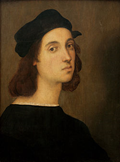
The artist Raphael Santi
1483 – Born in Urbino to an artist's family.
1500 – Began studies in the workshop of Pietro Perugino. Signed his first contract – the creation of the altarpiece “Coronation of St. Nicholas of Tolentino”.
1504 – 1508 – Lived in Florence, where he met Leonardo da Vinci and Michelangelo. Created his first Madonnas - "Madonna della Granduca" and "Madonna with the slit".
1508 – 1514 – Worked on the frescoes of the papal palace (frescoes such as “The School of Athens”, “The Expulsion of Peter from Prison”, etc.), painted a portrait of Pope Julius II. Obtained the position of scribe of papal decrees.
1512 – 1514 – Painted the “Sistine Madonna” and “Madonna di Foligno”.
1515 - was appointed chief keeper of the Vatican antiquities. Painted “Madonna in an Armchair”.
1520 – Died in Rome.
Pavlo Synichkin